Attic Insulation Cost Guide: What Boyle Heights Homeowners Pay in 2026
Most Boyle Heights homes need attic insulation work that costs between $2,800 and $6,200 in 2026. The spread is wide because your actual price depends on four things: how much material goes in, whether old insulation has to come out first, how much air sealing the attic needs, and whether the hatch gets upgraded. If you’d rather skip the research and get a straight number, call (855) 382-3938 and we’ll walk your attic with you.
We pulled an old cellulose job out of a 1947 bungalow off Cesar Chavez Avenue last month where three layers of insulation from three different decades had settled into something that looked more like damp cardboard than thermal barrier. That’s Boyle Heights reality. The cost-per-square-foot charts on national websites assume a clean, empty attic with standard joist spacing. Almost none of the pre-1960 housing stock here matches that description.
What Actually Drives the Quote: Four Line Items That Separate a Real Bid from a Low-Ball
When you get attic insulation quotes in Boyle Heights, the total number on the invoice breaks into four distinct line items. Contractors who bid cheap usually skip one or two of them. Here’s what a complete quote includes:
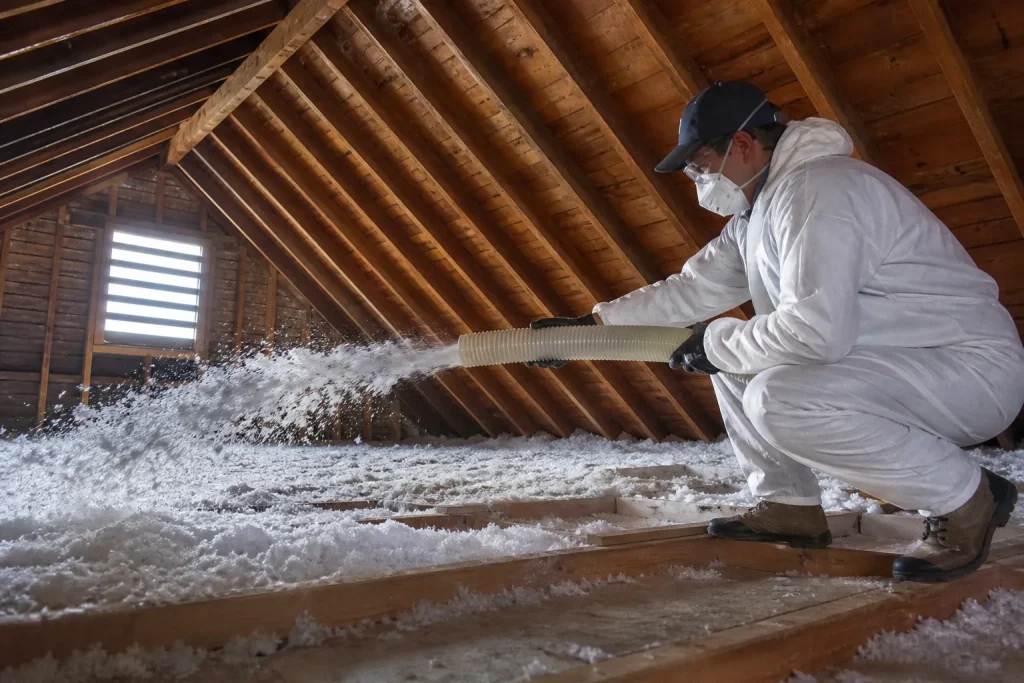
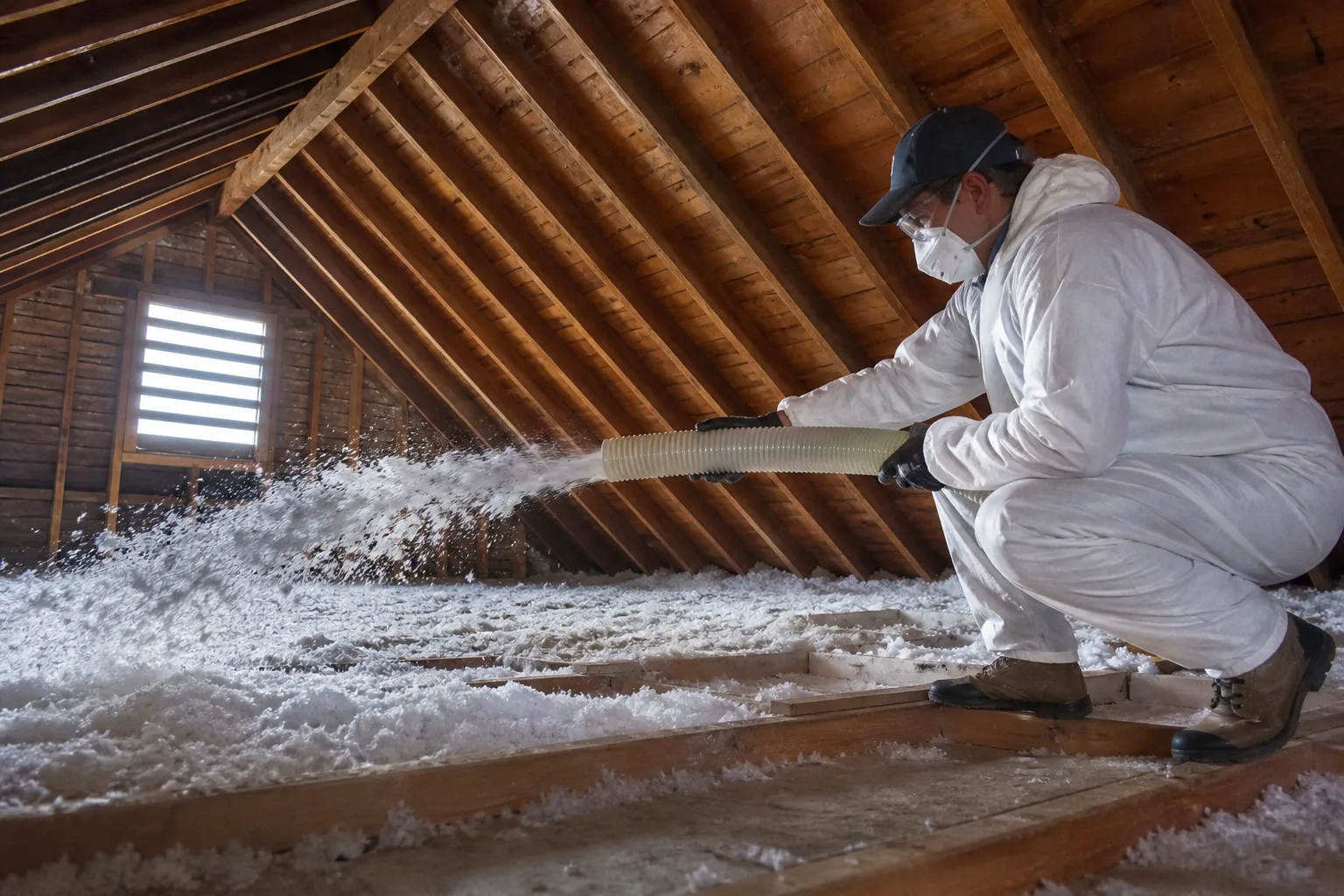
- Material cost – The insulation itself, priced per square foot at your target R-value. Blown fiberglass runs $0.80 to $1.20 per square foot installed. Blown cellulose, which we install using GreenFiber, runs $0.90 to $1.40. Open-cell spray foam is $2.50 to $4.00 per square foot because it air-seals while it insulates.
- Removal and disposal of existing material – This is the line item that surprises Boyle Heights homeowners most. If your attic has old loose-fill from the 1970s, rodent-damaged batts, or vermiculite that tests positive for asbestos, removal adds $800 to $2,500 depending on square footage, dump fees, and hazmat protocol when required.
- Air sealing – This is the step a low-ball bid skips entirely. Without sealing top plates, wire penetrations, plumbing chases, and the gap around the chimney chase, new insulation just filters air through itself instead of stopping it. Air sealing on a typical Boyle Heights attic adds $400 to $900 and is the highest-ROI line item in the quote.
- Attic hatch upgrade – A piece of drywall resting on trim leaks like an open window. Insulated hatches with weatherstripping run $150 to $350 installed and most Boyle Heights attics need it.
Why Boyle Heights Housing Stock Makes Cost Estimates Unreliable
Boyle Heights has one of the oldest housing inventories in Los Angeles. Drive down Fourth Street or past Hollenbeck Park and you’ll see 1920s bungalows, 1930s Spanish-style courts, and post-war stucco boxes. Each era creates its own attic cost drivers.
Low-slope roofs are the big one. Many pre-1950 homes here have pitches shallow enough that an adult can’t stand in half the attic. Insulating means crawling on joists, working on your stomach, and sometimes pulling back roof decking from the top side. Labor hours double compared to a standard gable attic. We’ve done jobs in the flats south of 1st Street where the entire install happened through a 22-inch scuttle hole in a hallway closet.
Balloon framing is the second driver. Homes built before 1940 often have wall cavities that run uninterrupted from crawl space to attic, which means your attic insulation quote should include dropping fire blocking at the top plates. Skip it and your conditioned air pours straight up through the walls into the attic, insulation or not. A complete quote accounts for this. A cheap one doesn’t mention it because the contractor either doesn’t know or doesn’t want you asking questions.
Asbestos is the third. Vermiculite insulation, which shows up in a meaningful percentage of pre-1960 Boyle Heights attics, tests positive for asbestos often enough that we treat it as suspect until lab results say otherwise. Removal of asbestos-containing material requires licensed abatement, sealed containment, and disposal manifests. That’s a $2,000 to $5,000 line item before one dollar of new insulation goes in. If a contractor quotes you $2,500 total and your attic has vermiculite, they’re either not checking or not telling.
Material Options: What We Actually Recommend for Boyle Heights Attics and What Each Costs
The right material for your attic depends on whether your HVAC equipment lives up there, whether you use the space for storage, and what your air sealing plan looks like. Here’s the straight breakdown for a typical 1,000 to 1,400 square foot Boyle Heights attic footprint, installed in 2026:
| Material | Installed Cost (1,000 – 1,400 sq ft attic) | Best For |
|---|---|---|
| Blown fiberglass (R-38) | $1,500 – $2,800 | Budget-focused jobs, standard attics |
| Blown cellulose (R-38, GreenFiber) | $1,800 – $3,200 | Older homes, better air-blocking, recycled content |
| Open-cell spray foam (roof deck, R-20) | $4,500 – $8,000 | Attics with HVAC equipment or storage, unvented assemblies |
| Closed-cell spray foam (R-30) | $6,500 – $11,000 | Limited-depth roof decks, moisture-prone areas |
Blown cellulose is the material we spec most often in Boyle Heights for vented attics. GreenFiber’s product packs tighter than fiberglass, which means it actually stops air movement instead of just slowing it. That matters in a neighborhood where 90-year-old houses breathe through a hundred unsealed gaps. For attics where the furnace lives up top, though, we move toward open-cell spray foam on the roof deck, using Icynene or Demilec depending on the assembly. It keeps the ductwork inside the thermal envelope instead of roasting in a 140-degree attic in August.
A note on vapor behavior: Boyle Heights sits inland enough that attic moisture usually comes from conditioned air leaking up through the ceiling, not from exterior humidity. That means air sealing matters more than vapor barriers. If a contractor’s proposal spends more time talking about vapor barriers than air sealing, that’s a flag.
How to Calculate Your Payback Period Using Your Own Utility Bills
Contractors love to promise “up to 30% savings.” You can do better than that with 10 minutes of math. Here’s the formula we give Boyle Heights homeowners:
- Pull your last 12 months of SCE electric bills and SoCalGas bills.
- Add up total annual cost. For a 1,200 sq ft pre-1970 home in Boyle Heights with no attic insulation, the combined figure typically lands between $1,800 and $3,200 a year.
- Estimate your savings percentage conservatively. Bringing an uninsulated attic to R-38 with air sealing typically cuts heating and cooling costs 20% to 30%. If your attic already has some insulation, expect 10% to 20%.
- Multiply annual spend by your expected savings percentage. That’s your annual dollar savings.
- Divide your project quote by annual savings. That’s your break-even in years.
Example: You spend $2,600 a year on energy, your quote is $4,200, and you conservatively expect 25% savings. That’s $650 a year back in your pocket. $4,200 divided by $650 means you break even in about 6.5 years. Most insulation jobs in Boyle Heights pay back in 4 to 9 years, and quality materials last 30 or more.
Rebates and Tax Credits: What’s Actually on the Table in 2026
The federal 25C tax credit still covers 30% of insulation and air sealing costs in 2026, capped at $1,200 per year for the insulation portion. That’s a direct dollar-for-dollar reduction on your federal taxes, not a deduction. You can qualify every year, which means some Boyle Heights homeowners split their project across two calendar years to capture the credit twice.
On the California side, SCE and SoCalGas both run residential insulation rebate programs that shift year to year. Most cover blown-in attic insulation and attic air sealing at $0.25 to $0.50 per square foot. What catches people is the documentation requirement: you need itemized invoices that separate material, labor, and air sealing, plus proof of R-value installed, plus before-and-after photos in many cases.
Here’s where working with a specialty contractor changes the experience. Because insulation is all we do, every Heartland Insulation Co invoice is formatted for rebate submission from day one. We photograph the attic before, during, and after. We document the exact material brand and bag count. When your rebate form asks for “manufacturer specification sheet” and “R-value certification,” you’ll already have it in a folder. That’s not a service we upsell; it’s just how a single-trade insulation crew works.
One more thing on rebates: if you’re in a LADWP service area rather than SCE, the program rules differ. Boyle Heights splits between utilities in places, so don’t assume your neighbor’s rebate applies to you. Check your bill and check your utility’s current program before you commit to a scope.
Red Flags to Watch When Comparing Boyle Heights Insulation Quotes
After years of walking attics across Boyle Heights, we see the same five warning signs on low-ball bids:
- No removal line item when you clearly have old insulation sitting up there. You can sometimes layer new over old, but only if the existing material is dry, uncompressed, and free of rodent droppings. Most Boyle Heights attics we see fail at least one of those tests.
- No air sealing scope, just “blow in R-38.” Skipping air sealing is the single most common way contractors hit a price point that looks better than a complete quote. The insulation goes in, the air still moves through, and you’re calling someone else in three years wondering why your bills didn’t change.
- R-value quoted without testing depth. “R-38” means roughly 12 to 14 inches of settled blown fiberglass. If the quote doesn’t mention depth markers or attic rulers, assume they’re eyeballing it.
- No mention of the hatch. An uninsulated hatch is a 6-square-foot hole in your ceiling assembly. Skip it and you’re leaving the envelope open.
- Vermiculite ignored. If your attic has shiny, pebbly, gold-to-brown insulation that resembles cat litter, it needs testing before anyone disturbs it. Any contractor who starts blowing new material over it without raising the question is not someone you want in your home.
When to call a pro: if any of this makes your head spin, that’s normal. The reason attic insulation in Boyle Heights deserves a trained eye is that every house here has its own construction story. We spec the job before we sell the product, because the building science should make the call, not whichever material one contractor happens to stock. If you’re exploring options, take a look at spray foam insulation in Boyle Heights and blown-in insulation in Boyle Heights to see how the methods compare side by side.
The Bottom Line
Attic insulation in Boyle Heights costs between $2,800 and $6,200 for most 1,000 to 1,400 square foot homes in 2026, with spray foam jobs running higher. The number moves based on four things: material selection, existing insulation removal, air sealing scope, and hatch work. Older housing stock, low-slope roofs, and balloon framing in Boyle Heights push labor higher than national averages, which is why local experience matters more than a national cost chart. Federal and utility incentives can shave $1,200 to $2,500 off your net cost, but only if the contractor documents everything properly.
If you’re in Boyle Heights and want a straight answer on what your attic needs and what it’ll cost, Heartland Insulation Co offers free estimates. Call (855) 382-3938 and we’ll come look at your attic, tell you what’s up there, and give you a number that covers the whole job, not just the easy half.
Frequently Asked Questions
Most Boyle Heights attics cost between $2,800 and $6,200 to insulate properly in 2026, including material, air sealing, and hatch upgrades. Blown fiberglass runs $1,500 to $2,800, blown cellulose $1,800 to $3,200, and open-cell spray foam $4,500 to $8,000 for a 1,000 to 1,400 square foot attic. Call (855) 382-3938 for a free, specific quote on your attic.
DIY blown-in insulation from a home center rental machine runs $500 to $900 in material for a small attic, but you’re buying material at retail, renting the machine, hauling bags through your house, and skipping air sealing, removal, and hatch work. Boyle Heights attics with old material, low clearance, or vermiculite need professional handling. The labor portion of a pro quote is usually $600 to $1,200, and most homeowners tell us it’s the best money in the project.
A standard blown-in job with air sealing and hatch upgrade takes one full day for a crew of two. Spray foam roof decks take one to two days depending on square footage and cure time. Removal of old insulation adds half a day. If asbestos abatement is needed, expect an additional two to three days for containment, removal, and clearance testing.
Yes, when it’s paired with air sealing. In our experience, Boyle Heights homes going from minimal insulation to R-38 with proper air sealing see 20% to 30% reductions in heating and cooling costs, which on a $2,600 annual energy bill means $520 to $780 back per year. Insulation without air sealing produces smaller savings because the conditioned air still leaks through the ceiling assembly.
Written by the team at Heartland Insulation Co, serving Boyle Heights since 2016.
Need Insulation Help?
Call Heartland Insulation Co — licensed & insured, here with fast after-hours help in Boyle Heights.
(855) 382-3938