
Fast, Reliable Spray Foam Insulation Across Monterey Park
Spray foam insulation in Monterey Park costs roughly $2,200 to $6,800 for a typical attic or garage retrofit, depending on square footage and whether we’re dealing with open-cell or closed-cell foam. Most Monterey Park jobs are done in a single day by a crew that works exclusively with insulation, not as a side line to HVAC or roofing. We’re based out of Boyle Heights, so our trucks reach Monterey Park neighborhoods in about 20 to 35 minutes depending on traffic off the 10 or 60. Call (855) 382-3938 and we’ll schedule a free estimate, walk the attic with you, and give you a straight answer about what your house actually needs.
Ruben Montoya runs our estimating team, and he’s spent enough time in Monterey Park attics to know what he’ll find before the ladder goes up: stucco ranch homes from the 1940s through the 1970s, shallow low-pitch roofs, and a lot of uninsulated framed cavities hiding behind drywall from old additions. That local pattern matters. A lot of spray foam contractors will sell you the same package they sold last week in Alhambra. A Monterey Park house isn’t the same house.
Why Heartland Insulation Co Is Monterey Park’s Preferred Spray Foam Insulation Company
Most insulation companies carry one brand and one method. We carry eight manufacturers, including Icynene and Demilec for spray foam, plus Rockwool, Owens Corning, Johns Manville, Knauf, CertainTeed, and GreenFiber. That matters more than it sounds. We’re not trying to fit your Monterey Park house into the only product we know how to install. We spec the job before we sell the product. Sometimes that’s open-cell foam on a garage ceiling. Sometimes it’s closed-cell on a rim joist. Sometimes it’s Rockwool batts in a knee wall and foam only where air-sealing demands it.
Our Spray Foam Insulation team handles Monterey Park calls weekly, and the review pattern from local customers tells the same story: the estimator crawled the attic, found problems the homeowner didn’t know existed, and the crew finished in a day, cleaned up, and left the house cooler the next afternoon. Ruben Montoya insists on that walkthrough. If an estimator quotes without looking at the cavities, the quote is a guess. We don’t do guesses in Monterey Park.
Insulation is all we do, so we do it right. No roofing, no HVAC, no general contracting. Every estimator and installer spends their whole week in building envelope science: air flow, vapor drive, thermal bridging, R-value math. When you call us for spray foam in Monterey Park, you’re not getting a contractor who bolted insulation onto a furnace replacement business. You’re getting someone who thinks about heat loss for a living.
Open Cell Spray Foam in Monterey Park
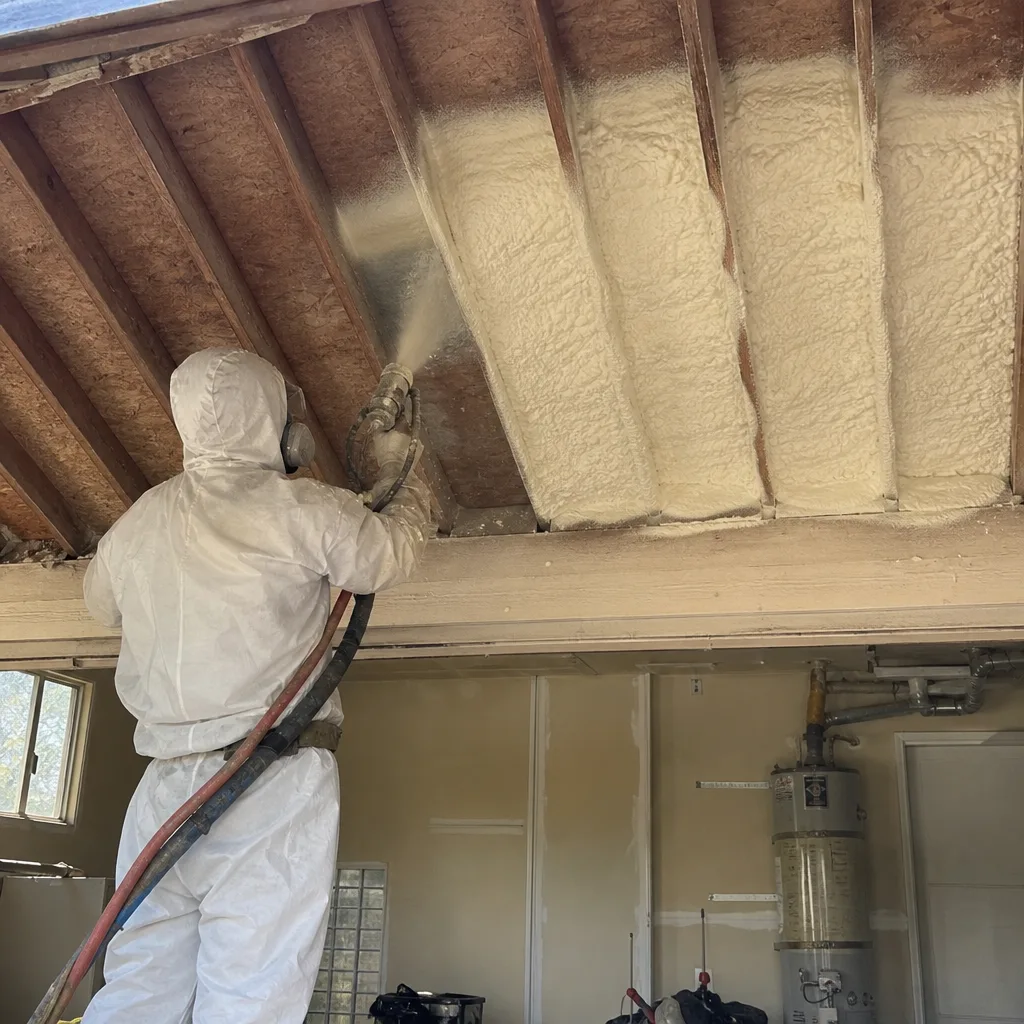
Open Cell Spray Foam in Monterey Park homes is our most common retrofit recommendation, especially for the shallow, low-pitch attics and converted garage bays we see throughout 91754, 91755, and 91756. Open-cell foam expands to fill irregular cavities, seals air leaks, and delivers roughly R-3.5 per inch. It’s also lighter and less expensive than closed-cell, which makes sense when the goal is air-sealing and heat management in a dry climate where vapor intrusion isn’t the dominant threat.
Right now, a typical open-cell spray foam job in Monterey Park runs $1.80 to $2.60 per board foot installed, with most full attic retrofits landing between $2,800 and $5,400. Smaller jobs, like a single garage ceiling or a rim joist band, typically fall in the $900 to $1,800 range. The price depends on cavity depth, access, and how much prep work we need to do before spraying.
Shallow Attics and Tight Clearances
Homes in the older hillside-adjacent tracts off the 10 and 60 freeways often have roof pitches low enough that a grown adult has to crawl on their stomach to reach the eaves. That changes the install method. We plan for tight-clearance baffle work first: routing intake air from the original vented soffits so the foam doesn’t choke the attic’s breathability.
Without that step, sprayed foam on the roofline traps heat in the peak and bakes the ceiling below. We’ve measured ceiling cavities in Monterey Park at 130°F in August because the original insulation had flattened to an inch and the soffits were clogged with decades of dust.
Garage Ceilings and Converted Spaces
Monterey Park has a lot of converted garages. Some are permitted, many aren’t, and nearly all of them have bare framed cavities behind drywall that were never insulated. Open-cell foam is often the right retrofit there: it fills the cavity completely, air-seals the perimeter, and doesn’t leave the voids that batt insulation does in irregular framing.
Spray Foam Insulation Contractors in Monterey Park
Spray Foam Insulation Contractors in Monterey Park should be able to answer two questions before they quote: what’s in your wall cavities right now, and what’s happening at your attic’s soffit line. We ask both on every estimate. Ruben Montoya trains our estimators to start every Monterey Park walkthrough at the attic hatch, then trace air movement through the house’s transitions: kneewalls, rim joists, can lights, plumbing chases, and the seam where an old addition meets the original framing.
When a Monterey Park homeowner calls us about spray foam, they usually want hot upstairs or hot back-of-house rooms fixed. Our first move is rarely “spray everything.” We look for the air leaks first. The foam is the tool; the air-sealing is the fix.

Rim Joists and Foundation Transitions
Rim joist spray foam in Monterey Park homes addresses one of the sneakiest heat-loss paths in this housing stock. The joist bays where floor framing meets the foundation are rarely insulated in 1940s – 1960s construction. Closed-cell foam in those bands cuts drafts that run through wall cavities and shows up as cold floors in winter, even in our mild San Gabriel Valley winters.
Roof Deck Application
Spray foam roof deck work in Monterey Park applies when the attic houses ductwork, a furnace, or a storage space, or when the owner wants to bring the attic into the conditioned envelope. The pitch of the roof matters more than anything else here. A very shallow roof deck limits foam depth, which means we may recommend a hybrid: foam for air-sealing, then blown-in cellulose or Rockwool over the foam layer to reach target R-value without overloading the structure.
Trusted Brands We Service in Monterey Park
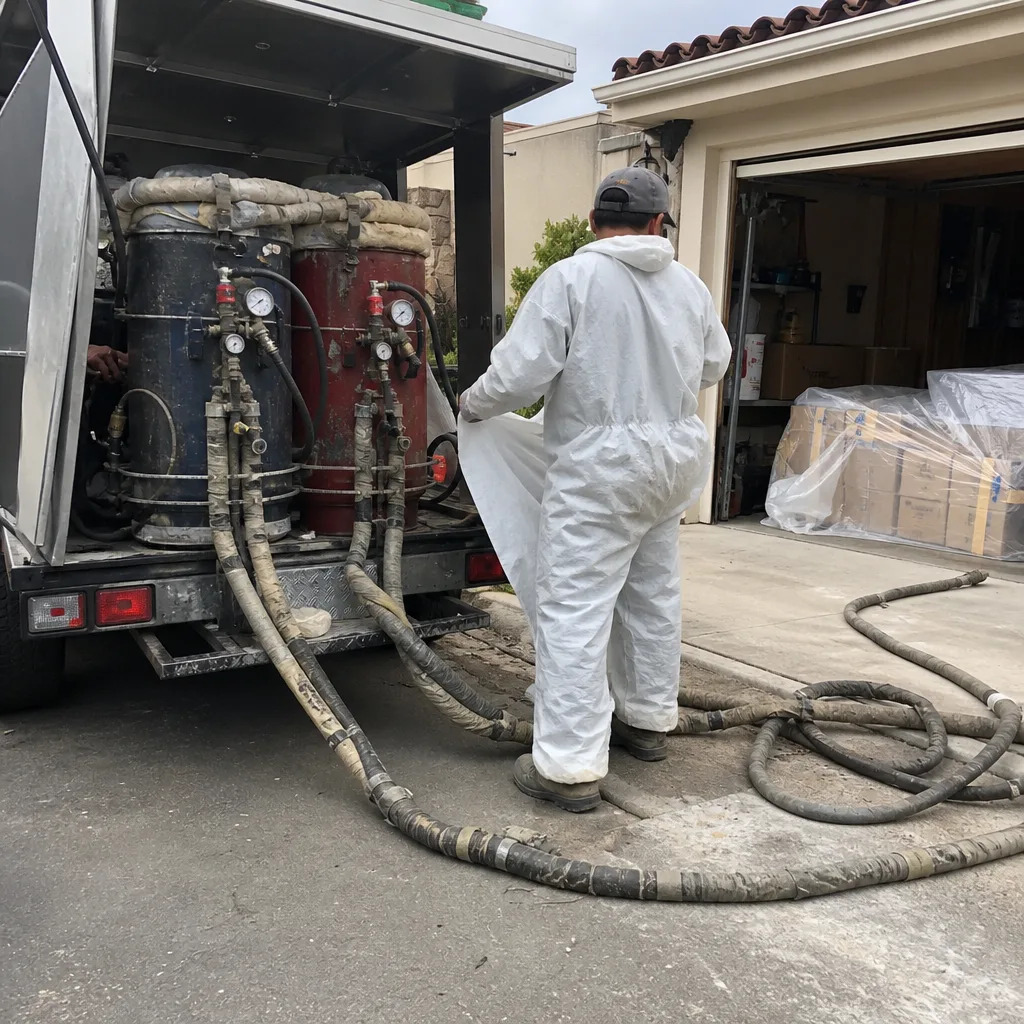
We install spray foam from Icynene and Demilec, both of which require manufacturer-level training and certification. Those aren’t commodity lines you can pick up at a supply house and figure out on the job. That certification matters in Monterey Park because spray foam installed by an untrained crew causes the exact problems homeowners later call us to fix: off-ratio foam, chemical smells that never cure, shrinkage, and under-performance. We also stock Rockwool for fire-resistant applications and GreenFiber cellulose for vapor-open retrofits on older mixed-construction homes. Eight brands, one goal: no heat lost. We keep common board-foot volumes and accessory parts for Monterey Park jobs in our Boyle Heights yard, which means we’re not ordering material and hoping it arrives before your install date.
Common Spray Foam Insulation Problems We See in Monterey Park Homes
- Foam over flattened attic insulation without addressing low-pitch roof heat traps. Many Monterey Park attics have original fiberglass batts compressed to R-5 or worse. Spraying foam over them without removing or resolving the existing material creates a thermal sandwich that overheats the foam and shortens its life.
- Foam sprayed without air-sealing vented soffits in shallow attics. The original soffit vents on 1950s Monterey Park ranch homes were designed for passive airflow. Foaming the roofline without baffling the soffits chokes that airflow and can concentrate moisture at the eave, even in our dry climate.
- Foam applied directly over bare drywall in converted garages without checking cavity depth. Monterey Park has a lot of unpermitted additions and garage conversions. We regularly find walls where the framing is 2×3 instead of 2×4, or where drywall was hung over old plaster, leaving shallower cavities than the homeowner assumes. Foam in a shallow cavity can’t reach proper R-value, and condensation follows.
- Off-ratio or uncured foam from previous contractor jobs. A bad spray foam job is worse than no insulation at all. We’ve walked into Monterey Park homes where the previous foam was still soft months later, off-gassing and doing nothing for air-sealing. Fixing it means cutting it out and starting over. That’s a five-figure mistake made by someone who wasn’t trained on the material.
Pricing for Spray Foam Insulation in Monterey Park, CA
A typical open-cell spray foam attic retrofit in Monterey Park runs $2,800 to $5,400. Closed-cell jobs run higher, usually $4,500 to $8,500 for a full attic, because the material cost is roughly double and the application requires more control. Rim joist bands run $900 to $1,800. Garage ceiling spray foam runs $1,200 to $2,700 depending on cavity area and access. Roof deck applications are the most variable here: a shallow low-pitch roof with poor access can push labor higher, and a full roof deck spray in a 1,400-square-foot Monterey Park ranch generally lands between $5,000 and $9,500. What moves the number: total board footage, cavity depth, how much prep work the existing insulation requires, and whether we need to do baffle and air-sealing work before spraying. We do free estimates, and our quotes are good for 30 days. Call (855) 382-3938 and we’ll give you a number that holds.
We Also Serve Cities Near Monterey Park
Our crews work throughout the San Gabriel Valley, including Monterey Park, where we’re in and out of crawlspaces every week. We also cover South San Gabriel, Alhambra, East San Gabriel, and East Los Angeles, so if your job straddles a city line or you have family nearby who need insulation work, one call gets the whole route scheduled.
Serving Monterey Park, CA — Our Local Coverage Area
We’re based in the Monterey Park area and know this community well. Use the map below to see our service coverage — if you’re nearby, we can almost certainly help.
FAQs About Spray Foam Insulation in Monterey Park
Yes, but only if the air-sealing is done first. The heat trap in a low-pitch Monterey Park attic comes from a combination of shallow space, vented soffits that are often clogged, and existing insulation that has compacted down to nothing. Spray foam alone won’t fix it. We cut in baffles at the soffit line to restore intake airflow, remove or remediate the flattened insulation, then apply open-cell foam to the roofline at the right depth for your roof structure. That stops the ceiling from baking. Call (855) 382-3938 for an exact quote on your attic.
We treat the cavity as unknown until we open it. Converted garages and unpermitted additions in Monterey Park are one of the main places we find uninsulated framed cavities behind drywall, and often the framing is non-standard: 2×3 studs, shallow rafters, weird transitions where the addition meets the original house. We’ll scope the cavity, verify the depth, and then choose the foam density that makes sense. In many cases, that’s open-cell, which fills irregular cavities better and air-seals the perimeter. We don’t spray blind, and we won’t promise an R-value that your framing can’t physically hold. Call (855) 382-3938 and we’ll scope your conversion in person.
Yes, in most applications. Monterey Park sits in the inland San Gabriel Valley, where summer highs routinely hit the 90s and 100s with very low humidity. The enemy here is radiant heat gain, not moisture. Open-cell foam is an excellent air-sealer and a solid thermal barrier, and its vapor-open character works fine in a dry climate. Where we recommend closed-cell instead is rim joists and any area exposed to bulk water or where vapor blocking matters. For most attic and garage cavity work in Monterey Park, open-cell is the right call for performance per dollar. Call (855) 382-3938 if you want us to look at your specific house.
We use Icynene and Demilec for spray foam work in Monterey Park. Both require manufacturer-certified training to install, which means the material is applied at the correct ratio, temperature, and thickness. A lot of bad foam jobs come from contractors using uncertified product lines and guessing at the chemistry. We don’t guess. We also carry Rockwool, Owens Corning, Johns Manville, Knauf, CertainTeed, and GreenFiber when the building science calls for something other than foam. The material follows the job, not the other way around. Call (855) 382-3938 for a product-specific recommendation.
Most Monterey Park ranch homes built between the 1940s and 1970s have empty wall cavities. The original construction predates Title 24 energy standards, so there’s often zero insulation between the stucco and the drywall. Spray foam fills those cavities completely and air-seals the wall assembly in one pass, whereas blown-in fiberglass or cellulose can settle and leaves air movement around outlets and framing. For the unpermitted additions and converted garages so common here, foam handles the irregular framing that batts can’t. The wall finally stops leaking conditioned air. Call (855) 382-3938 for a free wall-cavity assessment.
On a ranch home near Garvey Avenue in Monterey Park, we found a converted garage with uninsulated framed cavities behind drywall and a shallow attic where original soffit vents were clogged with dust. After air-sealing and applying open-cell spray foam to the garage walls and attic roofline, the homeowner reported the back room finally held temperature during a 100°F afternoon. That’s the job. That’s why we crawl the attic first.
Ready to get the heat out of your Monterey Park home? Call (855) 382-3938 today for a free, no-pressure estimate. Ruben Montoya or one of our estimators will walk the attic, scope the cavities, and give you a straight answer about what your house actually needs.
Written by Ruben Montoya, Owner at Heartland Insulation Co, serving Monterey Park and the San Gabriel Valley.