
Fast, Reliable Spray Foam Insulation Across Commerce
Spray foam insulation in Commerce usually runs between $1.50 and $4.50 per board foot depending on whether you need open-cell or closed-cell, and most jobs here take one to two days once we’re on site. If you live in the residential tracts off Telegraph Road or Washington Boulevard, you’re likely dealing with a 1950s or 60s home where the attic insulation has thinned to almost nothing after six decades of inland heat. We know those houses because we work on them every week. Heartland Insulation Co has been serving Commerce from our Boyle Heights location, which means we can usually have a crew at your door within a day or two of your call to (855) 382-3938. Ruben Montoya leads our crew, and he’s spent enough time in Commerce attics to know exactly what these homes need.
Why Heartland Insulation Co Is Commerce’s Preferred Spray Foam Insulation Company
Commerce is a specific kind of city. It’s industrial, dense, and squeezed between rail lines and freeways, so the insulation problems here don’t look like the problems in, say, Pasadena or Torrance. Our crews understand that a 1961 tract home backing up to the BNSF corridor needs sound attenuation as much as thermal performance. We factor that into every estimate. Homeowners along the 5 and 710 corridors regularly tell us they didn’t realize how much road noise was bleeding through their walls until we opened them up and showed them the empty cavities. That’s the kind of local knowledge you only get from a crew that works Commerce properties week after week.
Ruben Montoya built Heartland Insulation Co on a single-trade principle: insulation is all we do, so we do it right. We’re not an HVAC company that also happens to blow in some fiberglass. Every estimator and installer on our team lives and breathes building envelope science. We carry eight manufacturer lines because no single product is right for every Commerce home. A mid-century tract house with a low-pitch roof and no sheathing needs a different approach than a warehouse office near the rail yard. Our product-agnostic diagnostic process means we spec the job before we sell the product.
Spray Foam Attic Insulation in Commerce
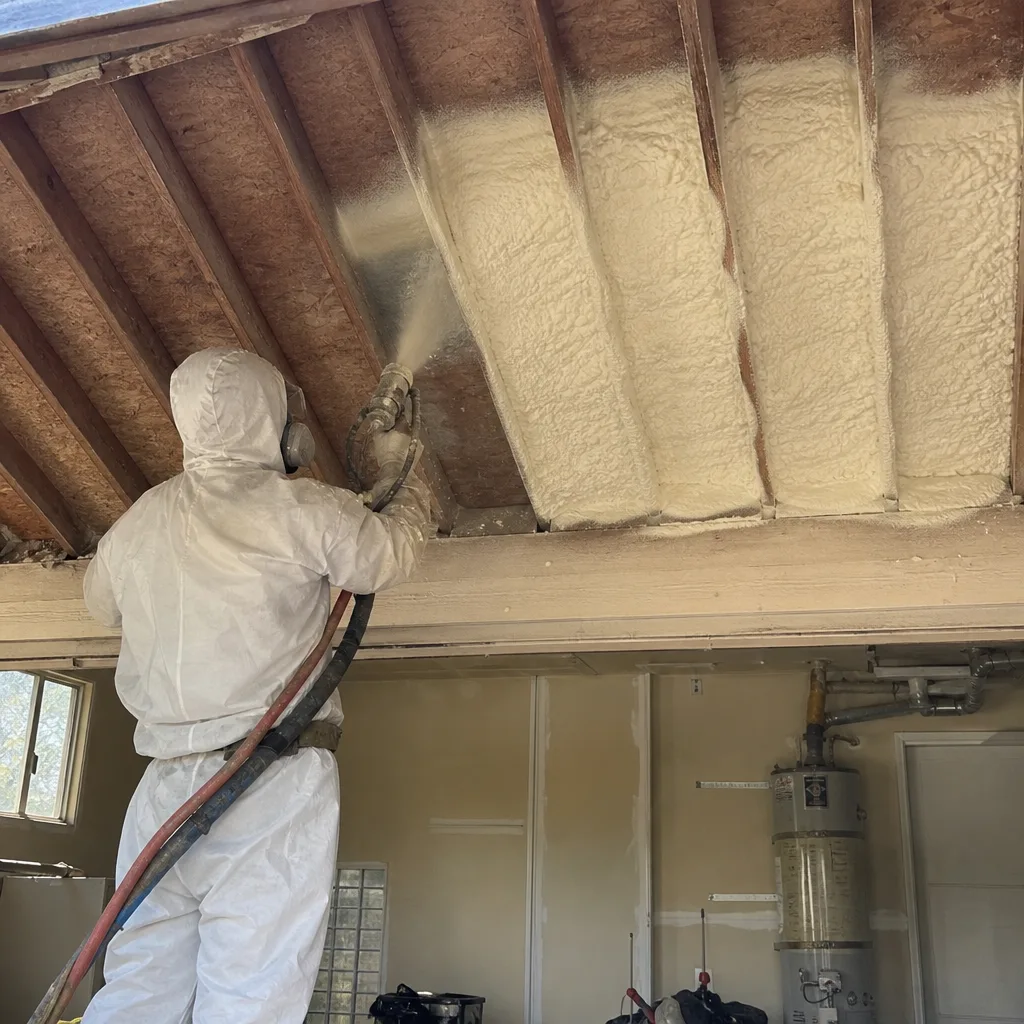
Spray Foam Attic Insulation in Commerce is one of the most impactful upgrades you can make to a 1950s or 60s tract home, because those attics were built with almost no thought given to thermal performance. Most have a thin layer of original batt insulation that’s been baked by sixty summers of inland LA Basin heat. In a hot, dry climate like Commerce, attic temperatures climb past 140 degrees in July and August, and all that heat radiates straight down into your living space. Closed-cell spray foam applied to the attic roofline creates an air seal and an insulating layer that stops that heat transfer at the source. The same application also cuts noise from the BNSF rail corridor that backs up against so many Commerce residential streets.
Roofline Foam for Low-Pitch Tract Homes
Commerce’s mid-century tract housing stock has a lot of low-pitch roofs, which means the attic space is tight and awkward. That’s actually a good fit for spray foam, because it conforms to the roofline without needing the clearance that batts or blown-in insulation require. We apply a 2-inch layer of closed-cell foam directly to the underside of the roof deck, which air-seals and insulates in one pass. For homes near the rail lines, this roofline foam also dampens the low-frequency rumble of passing freight trains in a way that fiberglass never will.
Knob-and-Tube Wiring and Ignition Barriers
Here’s something every Commerce homeowner should hear. Many of the 1950s and 60s homes in this city still have active knob-and-tube wiring running through the attic. Spray foam applied directly over live knob-and-tube is a genuine fire hazard, and any contractor who sprays over it without addressing it first is doing you a disservice. Our crew identifies this wiring before we ever start spraying. We install ignition barriers and can-light covers where needed, and we’ll tell you honestly if rewiring needs to happen before insulation goes in. We’ve seen too many attics in Commerce where someone cut corners on this, and it’s simply not acceptable.
Spray Foam Wall Insulation in Commerce
Spray Foam Wall Insulation in Commerce typically costs between $2,800 and $6,500 for the exterior walls of a standard mid-century tract home, depending on the wall area and whether we’re working from the interior or exterior. Most of these older homes have empty wall cavities or original insulation that’s settled into a useless mat at the bottom of each stud bay. Closed-cell foam injected into the cavities, or applied during a remodel when the drywall is open, fills every gap and creates both an air barrier and a thermal break. That matters in Commerce because the summers here are long and hot, and an uninsulated wall cavity is basically a radiator heating your home from late May through October.
Sound Attenuation for Rail-Adjacent Homes
If your Commerce home sits within a few blocks of the BNSF line or the 5/710 interchange, you already know the noise isn’t just background. It’s physical. Diesel engines idling at the rail yard, air brakes releasing, truck traffic on Bandini Boulevard at all hours. Spray foam’s density, especially closed-cell at 2 inches, measurably reduces the sound transmission through exterior walls. On a 1962 tract home near the rail line in the 90101 ZIP, our crew found the attic insulation collapsed and the wall cavities empty, letting in both diesel-train noise and summer heat. We removed the old batts, air-sealed the top plates and can lights, and applied 2 inches of closed-cell spray foam to the attic roofline and exterior walls, then finished with an ignition barrier. The homeowner reported a quieter house and a 20% drop in summer cooling costs.
Low-Density Foam and Stucco Crack Risk
One failure mode we see in older Commerce homes is the result of a bad foam choice. Low-density open-cell foam has its place, but injecting it into the wall cavities of mid-century tract homes that lack exterior sheathing can cause the foam to over-expand during curing. The pressure pushes outward against the stucco, and you end up with fine cracks running across your exterior walls. Our team assesses the wall assembly before choosing a foam. On unsheathed stucco walls, we use a lower-expansion closed-cell formulation that insulates without stressing the cladding. This is the kind of detail that separates a specialty insulation contractor from a generalist.
Trusted Brands We Service in Commerce
Heartland Insulation Co installs Spray Foam Insulation systems from manufacturers including Icynene and Demilec, plus Rockwool mineral wool for applications where fire resistance and sound dampening are priorities. We’re authorized to install products from eight manufacturers because no single foam chemistry works for every Commerce building. Our Boyle Heights facility is close enough that we keep the foam materials and equipment for Commerce jobs on hand without special ordering, which means faster turnaround on your project. When we recommend a specific product, it’s because the building science calls for it, not because it’s the only thing we know how to install.
Common Spray Foam Insulation Problems We See in Commerce Homes
- Sprayed-over knob-and-tube wiring without an ignition barrier. We see this in Commerce more than almost anywhere else because the housing stock is old enough to still have active knob-and-tube. It’s a fire risk that a proper ignition barrier or rewiring resolves before foam goes in.
- Open-cell foam in vented attics without adequate ventilation. Commerce’s hot, dry summers make this worse than people expect. If open-cell foam is applied to a vented attic without maintaining proper airflow, moisture gets trapped against the roof sheathing and condensation starts. The result is slow rot you won’t see until it’s expensive.
- Low-density foam in unsheathed wall cavities cracking exterior stucco. Many 1950s and 60s Commerce homes have stucco applied directly over the framing with no plywood or OSB sheathing. Injecting expanding low-density foam into those cavities pushes outward and hairline cracks appear on the exterior. It’s preventable with the right product choice.
- Ignoring the can lights. Recessed light fixtures in Commerce attics act like chimneys, leaking conditioned air into the attic every hour of every day. Foam applied around them without proper covers or boxes just seals the problem in. We address the cans before we spray.
Pricing for Spray Foam Insulation in Commerce, CA
We Also Serve Cities Near Commerce
If you’re reading this from a neighboring community, we handle spray foam work in Commerce, Maywood, Bell, Cudahy, and Bell Gardens. Our Boyle Heights location puts us within 15 minutes of most of these areas on a normal day, and we know the housing stock across all of them. Wherever you are, the diagnosis is the same: we tell you what your building needs, and we install it right.
Serving Commerce, CA — Our Local Coverage Area
We’re based in the Commerce area and know this community well. Use the map below to see our service coverage — if you’re nearby, we can almost certainly help.
FAQs About Spray Foam Insulation in Commerce
Yes. Closed-cell spray foam at 2 inches of depth measurably reduces sound transmission through walls and rooflines, and it’s the most effective single product we install for cutting rail and freeway noise in Commerce homes. The air-sealing effect matters as much as the foam’s density, because sound travels through gaps and cracks more than through solid materials, which is why our Reflectix repair in Commerce jobs always start with sealing first. For the strongest noise reduction on homes backing up to the BNSF corridor or the 710, we recommend closed-cell foam on the roofline and exterior walls, which addresses both the thermal and acoustic problems at once. Call (855) 382-3938 and we’ll assess your specific exposure.
Not directly over the wiring, and any contractor who says otherwise is creating a fire hazard. Spray foam applied over live knob-and-tube wiring traps heat against the conductors and can ignite the insulation. We inspect every Commerce attic before spraying, and if we find active knob-and-tube, we’ll recommend rewiring the affected circuits first, or at minimum installing an ignition barrier that meets code. We’ve done enough of these retrofits in the 90101 ZIP to know how to sequence the work so you’re not left without insulation during the project. Call us at (855) 382-3938 for a straight answer on your specific attic.

Closed-cell spray foam at 2 inches is the best choice for most low-pitch roofs in Commerce, because it delivers high R-value per inch and acts as an air barrier in one application. Low-pitch attics have tight clearances, so a product that needs less depth to perform well is a practical advantage. Closed-cell foam also adds structural rigidity to older roof decks, which is a bonus on 60-year-old framing. The caveat is always the wiring and can lights, which we address before spraying. For an exact recommendation based on your roof, call (855) 382-3938.
In most cases, spray foam insulation in Commerce does not require a standalone permit when it’s part of a retrofit that isn’t changing the building’s structure or envelope opening. However, if the job involves adding a new vapor barrier or changing attic ventilation, building code requirements may kick in. We handle the code-compliance side for Commerce jobs, including ignition barrier requirements for attics with older wiring. Check with us on your specific property and we’ll tell you exactly what’s needed before any work starts.
Spray foam stops heat at the source. In Commerce, attic temperatures routinely exceed 140 degrees in July and August, and that heat radiates through your ceiling into the living space all day and into the night. Closed-cell foam applied to the roofline prevents that heat from entering the attic in the first place, which means your air conditioner doesn’t have to fight a 140-degree box sitting on top of your home. The result is lower cooling bills and a house that actually holds temperature through the afternoon. We’ve measured 20% reductions in summer cooling costs on Commerce homes after a proper roofline application.
Written by Ruben Montoya, Owner at Heartland Insulation Co, serving Commerce since day one from our Boyle Heights location.